


 The Federal Railroad Administration is currently managing a comprehensive planning effort to define, evaluate and prioritize future levels of investment in the Northeast Corridor (NEC) through 2040. This effort, launched in February 2012, called NEC FUTURE, will produce a Service Development Plan that articulates the overall scope, alternatives and approach for proposed improvements, and a Tier 1 Environmental Impact Statement that evaluates and identifies ways to address broad, corridor-wide environmental impacts due to these improvements. This process is a federally-required step before major construction to overhaul the corridor's aging, unreliable, and congested infrastructure can begin.
But, before the FRA could analyze the impacts of the multitude of visions for improved NEC rail service, first it needed to narrow down the alternative visions to a reasonable number by weeding out the alternatives that are clearly inferior to others. So far, they've winnowed the list down to 15 alternative visions. Earlier this week, the FRA published its new "Preliminary Alternatives" report, which contains descriptions of these 15 different visions of the NEC, ranging from mundane to ambitious. The FRA hopes to carry around 8 or 9 alternatives forward to the Tier 1 EIS process to be weighed against the "no action" alternative (essentially doing the bare minimum to keep the corridor operating safely). The FRA's goal is to have established a final preferred alternative by mid-2015.
The 15 alternative visions presented in the report have been grouped into four different program levels that vary according to the level of investment it will take to achieve and the quantity and variety of rail service types that will be available. The FRA has not produced cost estimates, but in general, alternatives in level A are low cost options and alternatives in level D will require a significant increase in future investment.
Preliminary Alternative Visions for NEC Rail Service & Infrastructure
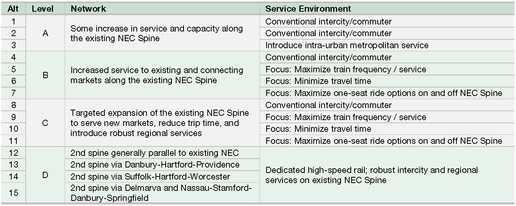
(click this image to view an enlarged version)
Alternatives in Level A would achieve a state of good repair and meet projected demand for rail travel through 2040 on the existing corridor by implementing projects that moderately increase service and capacity, but would not construct new routes or serve new markets.
Alternatives in Level B would achieve a state of good repair on the existing corridor and meet projected demand for rail travel through 2040 by expanding service to existing and connecting rail markets, but would not construct new routes. This program level assumes the rail mode share stays the same.
Alternatives in Level C would achieve a state of good repair on the existing corridor and create additional demand for rail service by serving new markets and growing existing markets by adding capacity and building new alignments in targeted locations, such as downtown Baltimore and Philadelphia. This program level assumes the rail mode share increases.
Alternatives in Level D would achieve a state of good repair on the corridor and create enough capacity to provide major increases in the quantity and types of rail services and significantly improve trip times to existing and new markets on and off the existing NEC. These alternatives all include building new main line tracks the entire length of the corridor and optimizing capacity on the existing NEC. This program level assumes the rail mode share increases significantly.
Download the NEC FUTURE Preliminary Alternatives Report


Leave a comment